Fear doesn't ask how justified it is — it just arrives first
September 8, 2026
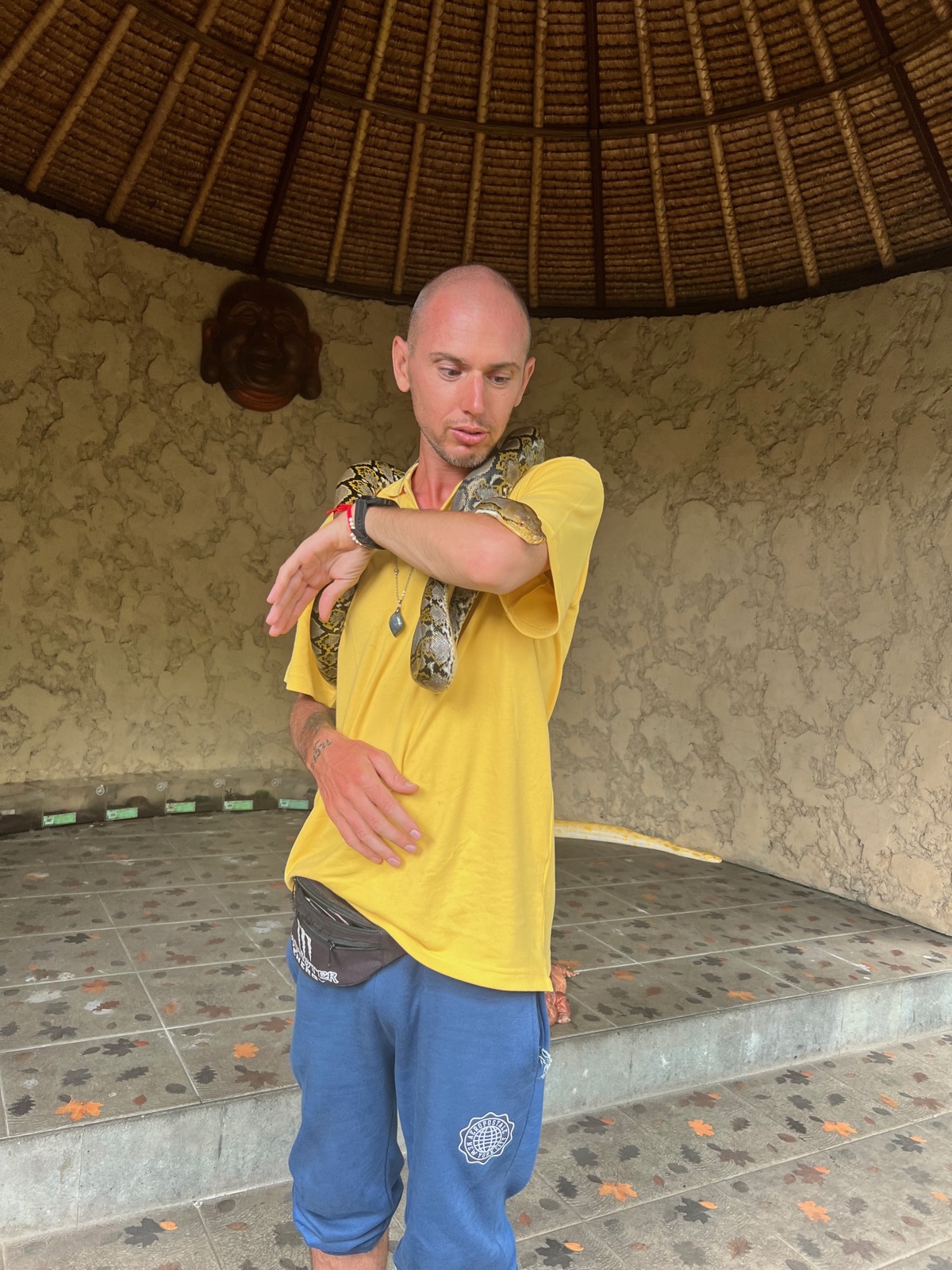
Fear doesn't ask how justified it is — it just arrives first
In this photo a python is draped across my shoulders, and I'm looking down at it. Honestly, my body's first reaction in that moment wasn't calm at all — my heart sped up, my arms tensed slightly, some ancient signal switched on inside that, from the body's point of view, made complete sense: something nearby might be dangerous.
And in the very same second, my mind already knew something else: this is a tame snake, used to people, nothing is going to happen, it isn't even coiling, just lying there. Two kinds of knowing at once — the body's fear and the mind's understanding — and in the moment you have to decide which one to trust.
Decisions in life work exactly the same way, just without the python. Fear almost never asks how justified it actually is in this specific situation — it arrives first and speaks louder than every other inner voice. Leaving a job, starting a conversation you've been putting off for years, trusting someone again after being burned once — the body reacts just as sharply to real danger as it does to something merely unfamiliar. It doesn't always know how to tell the two apart on its own.
I know a case where someone avoided a serious, long-overdue conversation with someone close to them for years, purely because of the sharp, physical anxiety it triggered — and took that feeling as a clear sign it was better not to. When we worked through where exactly that anxiety came from and what it actually resembled, it became clear: it wasn't danger, it was just unfamiliarity — the body wasn't afraid of the conversation's consequences, it was afraid of the sheer novelty of a situation it had never been in before.
Sometimes that's literally what a reading is about — sorting out which part of your fear is a genuine warning, and which part is just a loud, outdated habit of the body reacting.
The python, by the way, didn't move once the entire time — far calmer than I was in that moment.
About the author · Copyright · Privacy Policy
© 2026 Nikolai Chechelnitskiy (Nikola Blajen). All card artwork and texts are copyrighted.